Types of Tabletop Games
“Tabletop game” is a shelf label, not a single kind of night. Monopoly, chess, Pandemic, and Codenames all live on a table, and almost none of them ask you to do the same thing. One sends a piece around a track collecting cards. Another asks the whole table to lose or win together. A third is mostly conversation and a hidden role.
If game night keeps going sideways, the mismatch is usually the type, not the people. A table that wants to talk and accuse will suffer through a quiet efficiency puzzle. A table that wants a shared problem will fight a game built on elimination. The useful map is how the game actually works.
Categories overlap. A box can be a cooperative deck-builder, or a competitive tile-layer with a campaign strapped to it. The labels below describe the main experience, not a sealed genre.
The piece on the track
This is the pattern most people mean when they say board game. You roll a die, move a piece that many spaces, and resolve whatever the space says. Draw a card. Pay rent. Lose a turn. Race to the end.
The board is a track more than a map. Skill is light. Timing, card draws, and the dice do most of the work. Candy Land is the pure version: no choices, just the path. Monopoly and The Game of Life add property, money, and a few decisions, but the spine is still roll, move, collect or pay. Snakes and Ladders belongs here too.
There is nothing wrong with that night. It is familiar, it fills a table, and nobody has to learn a system. It is also one type of tabletop game, not the type.
No story required
Abstract strategy throws the theme out, or keeps it as wallpaper. The pieces, the grid, and the rules are the whole game. Both players can usually see everything. Dice rarely decide the outcome.
Chess, Go, checkers, and mancala have been doing this for centuries. Newer boxes such as Hive, Santorini, and Azul keep the same promise in brighter colors: spatial puzzles, blocking, pattern-building. You are not collecting cards or telling a story. You are out-positioning the person across from you.
These games reward the player who can see three moves ahead. They also punish the player who cannot, which is why they make excellent two-player nights and terrible icebreakers.
Planning, not punching
Euro-style games grew up in a design tradition that treats the table like a shared puzzle. You are racing other players for the same limited actions and resources. Direct attacks are rare. There are usually several ways to score, and nobody gets knocked out at minute twenty.
Three habits show up again and again.
Worker placement is the one that feels most like a job. You put a meeple on an action space to claim it. Spaces are limited, so taking the good one denies it to everyone else. Agricola, Lords of Waterdeep, and Viticulture are built on that squeeze.
Engine building is the slow burn. Early turns buy or build things that make later turns stronger: more resources, better cards, faster production. The game accelerates as your little system comes online.
Resource conversion is the trade at the heart of Catan. Gather, swap, build, score. The dice are a shared constraint, not the whole game.
These can look dry on the shelf. What they offer is decisions that compound. A bad opening does not end you. It just means you spend the next hour trying to catch the person who opened better.
The story comes first
American-style games, sometimes nicknamed Ameritrash with affection, flip the priority. Theme leads. Zombies, haunted houses, galactic empires, dungeon crawls. Dice, cards, and sudden reversals are welcome. Conflict is often direct. You can be eliminated, ambushed, or buried under a bad roll.
Talisman, Zombicide, Arkham Horror, and Twilight Imperium sit here. The systems serve the fiction. A night can swing on a single die, and that is the point. If a Eurogame feels like optimizing a workshop, these feel like surviving a movie.
Everybody loses together
Cooperative games put the whole table on one team. The opponent is the game: a spreading disease, a rising threat track, a timer, a deck that gets worse as you play. You win together or you lose together.
Pandemic is the reference point. Players move around a map, treat outbreaks, and hand cards across the table because no one can cover the board alone. Forbidden Island, Horrified, and Spirit Island are the same idea at different weights. Some co-ops add a traitor, so the table is cooperating until it isn’t.
This is the cleanest contrast with the piece on the track. In Monopoly you are collecting against everyone else. In Pandemic the cards are a shared problem, and hoarding them is how you lose.
Cards, three different ways
“Card game” hides three different nights.
In deck-building you start with a weak, identical deck and improve it while you play. You play cards to gain currency or effects, spend that currency in a shared market, and shuffle the new cards into your deck. Over the night your pile becomes an engine. Dominion invented the modern form. Star Realms pushes the same idea toward direct attacks.
Deck construction happens before anyone sits down. You build a personal deck from a large pool, under a points limit or a format, then bring it to the table. Magic: The Gathering and Pokémon are the famous versions. The match tests the list you already made, plus how you play it.
Drafting sits between them. In 7 Wonders you take a hand, pick a card, and pass the rest. Your tableau is whatever you drafted, and the cards you leave shape what the next player can take. The interaction is in the passing, not in a fight.
Fighting over the map
Area control treats the board as territory. You place, move, or support pieces to hold regions, and holding them pays you in points, resources, or the win. Majority often matters more than total ownership. Two armies in a region beat one.
Risk is the mass-market version, heavy on dice and elimination. El Grande, Blood Rage, and Root keep the fight for the map and change how nasty or puzzle-like that fight feels. Root is a useful reminder that one category can hold very different games. Everyone is contesting the same woodland, but each faction plays by its own rules.
You build the board as you go
Tile-laying starts with an empty table and a stack of pieces. You draw or draft a tile and add it to a shared or personal map. Placement is the decision. A road has to connect. A color has to match. A city scores only if you close it.
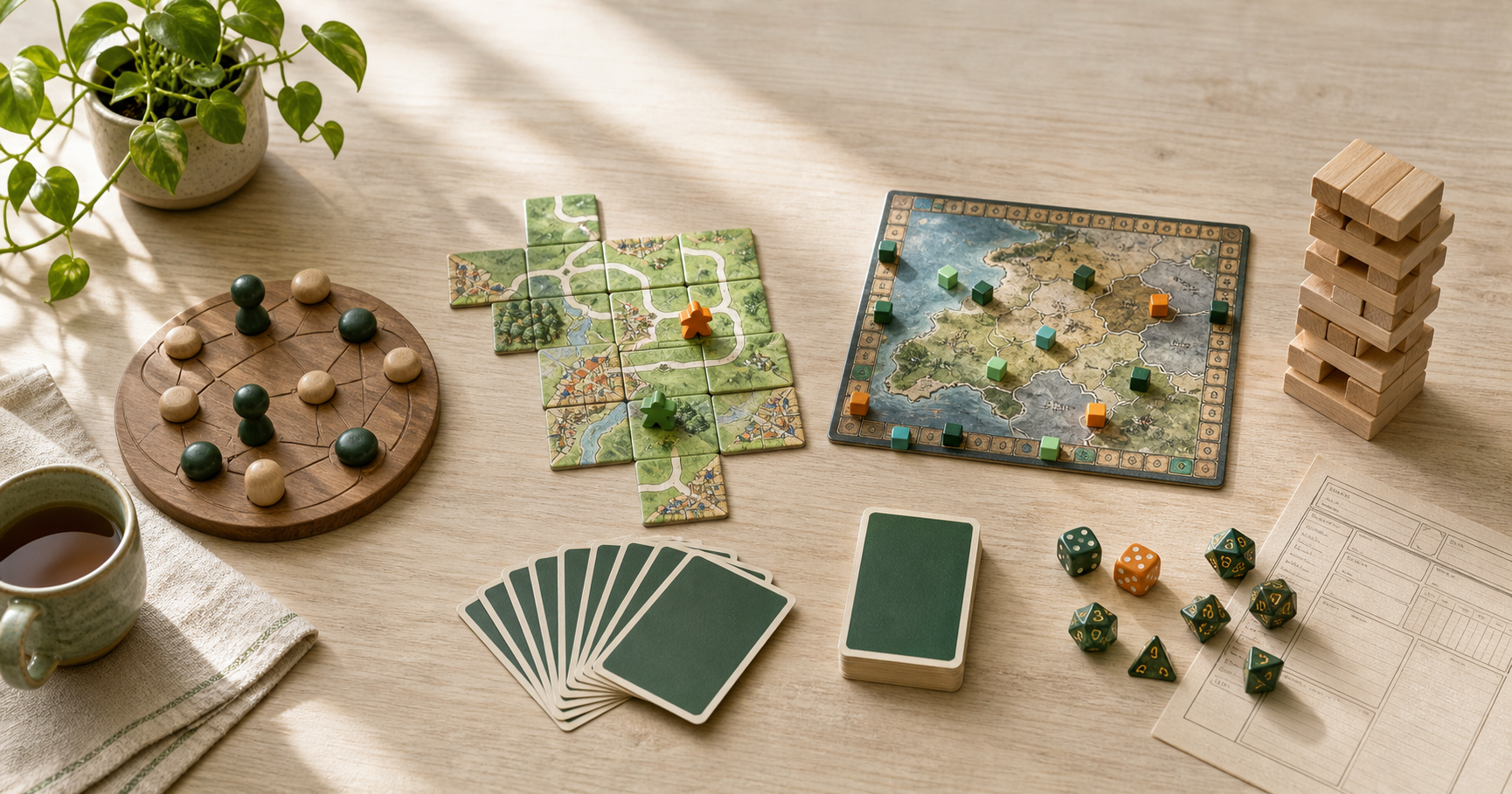
Carcassonne is the classic: tiles build the countryside, meeples claim roads, cities, and fields. Kingdomino and Patchwork shrink the same idea to a few minutes. The board does not exist until the players make it, which is why these games photograph well and teach quickly.
Someone at this table is lying
Social deduction deals roles in secret. The informed players know the truth and must not look like they know it. Everyone else has to read faces, votes, and alibis.
Werewolf and Mafia are the folk versions, played with a deck of cards and a narrator. The Resistance and Secret Hitler tighten the voting so a bad read has consequences. One Night Ultimate Werewolf compresses the whole thing into a single round of accusations. The components are thin. The game is the conversation.
These fail if the table will not talk. They also fail if one person talks over everyone else. The type assumes a group that can accuse each other and still pass the snacks.
The crowd game
Party games are built for a larger group, a short rules explanation, and laughter over mastery. Turns are fast. Player count runs high. The skill, if any, is social: word association, bluffing, drawing, pitching an absurd answer.
Codenames is word clues under pressure. Wavelength is a hidden scale and a guess. Telestrations is telephone with a pencil. They are tabletop games in the literal sense, and they barely resemble a two-hour strategy game. That is their job. They fill the gap between dinner and the game that actually needs a teach.
The game that remembers
Most boxes reset when you pack them up. Campaign and legacy games do not.
A campaign chains scenarios. What you did last week changes the board, the deck, or the story next week, usually through a log or an app. The components survive.
Legacy games go further. Stickers on the board. Torn cards. Names written in pen. Risk Legacy and Pandemic Legacy made the format famous. You play through a season once. The box is not meant to go back in the closet unchanged.
The trade is obvious. You get a story that feels like yours. You also get a game you cannot easily lend, replay, or hand to a new group without spoilers.
Hands, not just heads
Dexterity games make the challenge physical. Steady hands, timing, flicking, stacking. Jenga is the household example. Crokinole and Klask reward aim. These sit at the edge of “board game” and the center of tabletop: the table is the arena, and a shaky hand is a legal move that goes wrong.
When the table is a world
Tabletop is wider than boards. In a role-playing game such as Dungeons & Dragons, there is often no winner. One person runs the world. Everyone else plays a character. Dice resolve risk. The session is a shared story with rules underneath.
Miniatures games use figures, measuring tapes, and army lists. Warhammer is the landmark. The “board” may be a table of terrain. That type is closer to a tabletop sport than to a race around a track.
Picking the night, not the ranking
None of these is the grown-up version of the others. A roll-and-move race, a worker-placement puzzle, a hidden-role argument, and a co-op against the box are different evenings that happen to share furniture.
Before you buy or teach, ask what the table is actually doing. Moving a piece and drawing cards? Placing workers on a shared action board? Building a deck as you play? Holding territory? Hiding a role? Solving the board together? Stacking blocks until they fall?
Answer that, and the box almost picks itself.